
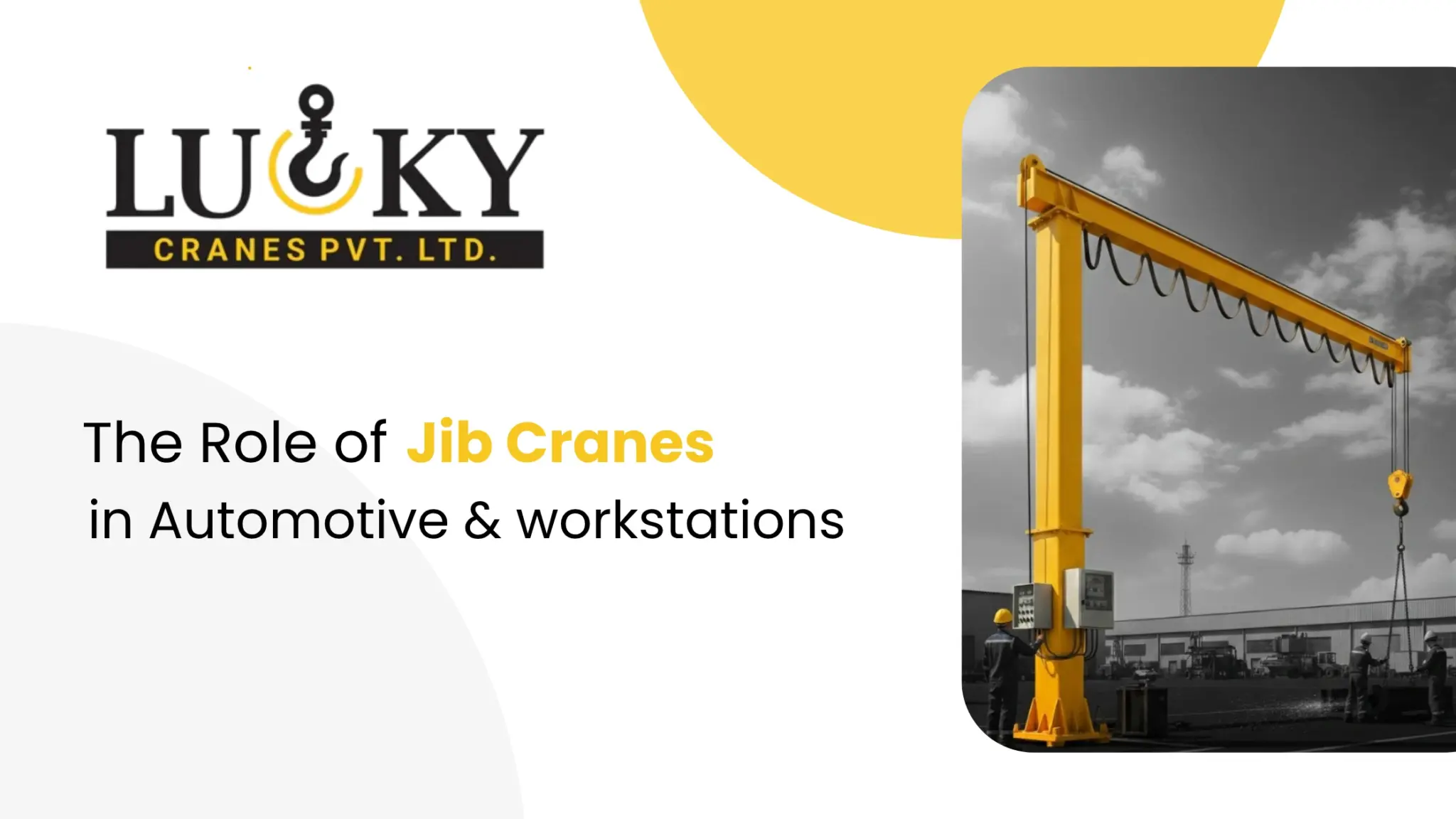
If you’ve ever walked through an automotive plant, you’ve probably noticed those rotating arm-like structures mounted on walls or pillars near workstations. Those are jib cranes, and honestly, they do a lot more heavy lifting (literally) than most people give them credit for.
In fast-moving manufacturing environments where every second counts, jib cranes have quietly become one of the most relied-upon tools on the shop floor. They are not flashy, but they’re incredibly effective.
What is a Jib Crane?
Simply put, a jib crane is a lifting device with a horizontal arm – called a “jib” or boom – that sticks out from a vertical mast or wall mount. The arm can rotate (anywhere from 180° to 360°), and a hoist runs along it to lift and move heavy loads within a specific work zone.
Think of it as a dedicated crane for a single workstation. Instead of calling in a big overhead crane every time you need to lift something, the jib crane is right there, ready to go. That kind of immediacy makes a huge difference on a busy assembly line.
Types of Jib Cranes Used in Automotive Plants
Not all jib cranes are the same. Depending on where you need them and what you’re lifting, you’d pick between wall-mounted cranes (great for perimeter stations), floor-mounted pillar cranes (perfect for central work islands with full 360° rotation), articulating cranes (for tight or cluttered spaces), or mast-type cranes (for high-bay areas with heavy loads). We’ll dig into each of these in detail later on.
Why Jib Cranes Are Essential in Assembly Lines
Here’s the thing about assembly lines, they run on rhythm. The moment one station slows down, it affects every station after it. Jib cranes keep that rhythm going by making sure workers never have to wait for a lift or wrestle with a heavy component on their own. They’re always there, always ready, and built for exactly the kind of repetitive work that assembly lines demand.
Importance of Jib Cranes in the Automotive Industry
Let’s be honest – automotive manufacturing is intense. You’re moving thousands of heavy parts every single day, trying to hit production targets while keeping workers safe and quality high. That’s a tough balance to strike, and jib cranes play a bigger role in achieving it than most people realize.
Enhancing Material Handling Efficiency
Think about what it takes to move an engine block manually. It’s heavy, awkward, and slow, and if something goes wrong, it’s dangerous too. A jib crane changes that completely. One operator can lift, swing, and position that same engine block precisely and repeatedly, without breaking a sweat. That speed and consistency add up to serious productivity gains over the course of a shift.
And because jib cranes can be fitted with custom attachments – vacuum grippers, magnetic lifters, ergonomic balancers – they can handle all kinds of irregularly shaped components that would otherwise take two or three people to move safely.
Supporting Just-in-Time (JIT) Manufacturing
JIT manufacturing is all about having exactly what you need, exactly when you need it. No excess, no waiting. For that to work, every component has to arrive at its station right on cue – and the moment it does, it needs to be lifted and installed immediately.
Jib cranes make that possible. Since they’re fixed at each workstation, there’s no waiting for a shared crane to become available. The instant a part shows up, it can be lifted. That kind of responsiveness is exactly what JIT demands.
Reducing Production Downtime
Downtime is expensive. Whether it’s an equipment breakdown, a worker injury, or a bottleneck at one station, stoppages cost money fast. Jib cranes are mechanically simple, built to last, and easy to maintain. They rarely break down unexpectedly, and when they do need attention, servicing is straightforward. That reliability is worth a lot when your production line can’t afford to stop.
Key Applications in Automotive & Assembly Units
So where exactly do you find jib cranes in an automotive plant? Pretty much everywhere, actually. Here are the key areas where they really earn their keep.
Engine Assembly Line Operations
Engine assembly is one of the most precise and demanding jobs in any auto plant. You’re working with heavy blocks, delicate tolerances, and a sequence that has to be followed exactly right. Jib cranes here are fitted with precision hoists and positioning fixtures so technicians can lower engines onto mounts and install components with millimeter accuracy – no guesswork, no straining.
In many plants, you’ll see a jib crane at virtually every station along the engine line, each one doing its specific job in the assembly sequence. It’s a well-choreographed operation, and the cranes are central to making it work.
Loading & Unloading Heavy Components
Receiving docks are busy, hectic places. Trucks are coming and going, components need to move fast, and you can’t afford accidents. Jib cranes at receiving bays let teams quickly unload heavy parts and transfer them to storage – without needing a forklift anywhere near pedestrians or delicate components. It’s safer, faster, and a lot less stressful.
Welding and Fabrication Support
Welding stations need components presented at exactly the right angle – and sometimes flipped partway through the job. That’s where articulating jib cranes shine. They can hold a component steady, rotate it as needed, and reposition it for the next weld run, all without the operator having to manhandle anything heavy. For robotic welding cells, jib cranes serve as the feeding mechanism that keeps the robot supplied without human intervention.
Paint Shop Handling Solutions
Freshly painted surfaces are fragile. One accidental bump and you’ve got a defect that needs to be reworked – which is costly and time-consuming. Jib cranes in the paint shop are configured with soft-grip attachments and vibration-dampening hoists to move panels and trim pieces gently, without any contact that could mar the finish. It’s a delicate job, and the right crane setup makes all the difference.
Benefits of Using Jib Cranes in Assembly Units
If you’re still wondering whether a jib crane is worth the investment, let’s break down the real-world benefits – the ones that show up on your safety records, your production reports, and your bottom line.
Safety
Workers handle controls, not heavy loads. Musculoskeletal injuries drop dramatically when the crane does the lifting.
Productivity
Faster, more consistent lifts at every station mean tighter cycle times and a smoother assembly line overall.
Space
A jib crane serves its zone without taking up floor space. No forklifts, no wide turning radii to worry about.
Cost
Far more affordable than a full overhead bridge crane system, with lower installation time and minimal upkeep.
Improved Worker Safety and Ergonomics
No one should be wrestling a 200 kg engine block into position by hand. But without proper equipment, that’s exactly what happens – and it leads to injuries that sideline skilled workers for weeks or months. Jib cranes remove that risk entirely. Workers guide the load; the crane carries it. Add an ergonomic balancer to the mix and the load feels virtually weightless. That’s a game-changer for worker wellbeing and long-term retention.
Increased Productivity and Workflow Optimization
Here’s a simple truth: a workstation with its own jib crane never has to wait for a shared crane to become available. That autonomy is incredibly valuable. Multiply it across ten, twenty, or fifty stations, and you’re looking at a significant improvement in overall line efficiency – all from removing one small but persistent source of delay.
Space-Saving Design for Compact Facilities
Not every plant has the ceiling height or structural capacity for overhead bridge cranes. And not every area of a plant needs full overhead coverage. Jib cranes solve that problem neatly – they put lifting capability exactly where you need it, without requiring major structural modifications. Wall-mounted versions are especially compact, freeing up floor space under the crane for workbenches and tooling.
Cost-Effective Material Handling Solution
Compared to installing an overhead crane system, a jib crane is a fraction of the cost in equipment, installation time, and ongoing maintenance. For manufacturers who want to upgrade specific stations without a full infrastructure overhaul, jib cranes are often the smartest path forward. The ROI is typically fast, too, especially when you factor in reduced injury costs and improved output.
Types of Jib Cranes Used in Automotive Plants
Choosing the right type of jib crane really comes down to your space, your workflow, and what you’re lifting. Here’s a quick rundown of the main options:
Wall-Mounted Jib Crane
It is bolted to a structural wall. Great for perimeter stations where you don’t want anything on the floor. Wall-mounted Crane Rotates up to 180°.
Floor-Mounted Pillar Crane
Anchored to the floor slab. Works beautifully as a standalone crane at the centre of a work island. Full 360° rotation.
Articulating Jib Crane
Multi-joint boom that bends around obstacles. Perfect for tight, cluttered spaces where a straight boom just won’t fit.
Future Trends in Jib Crane Technology
Jib cranes have been around for a long time, but they’re far from standing still. The next generation of these machines is getting smarter, more connected, and more capable, and the changes coming are genuinely exciting for anyone running a modern manufacturing operation.
Trend 01
Smart & Automated Jib Cranes
Newer models can execute programmed lift sequences on their own, with sensors to avoid collisions and servo controls for precise positioning. Less operator input, more consistent results.
Trend 02
Integration with Industry 4.0
Cranes are being connected to MES and ERP platforms, feeding real-time data on cycle times and equipment usage directly into the broader manufacturing intelligence system.
Trend 03
IoT-Based Monitoring
Embedded sensors track load stress, bearing temperatures, and usage cycles in real time. Predictive alerts flag components that need attention before they actually fail – goodbye unplanned downtime.
The plants that invest in these smarter systems now will be operating with a significant competitive advantage in five to ten years. The technology is there – it’s really just a matter of when, not if.
Conclusion
When you step back and look at everything a jib crane does – keeping workers safe, supporting JIT workflows, cutting downtime, enabling lean manufacturing – it’s clear that these aren’t optional extras. They are core infrastructure for any serious automotive or assembly operation.
The good news is that getting started doesn’t require a massive investment or a full facility overhaul. Even installing a jib crane at a single high-demand workstation can deliver measurable improvements in safety and productivity quickly.
If you’re evaluating your material handling setup and wondering where to start, jib cranes are a solid answer. They’re proven, versatile, and when specified correctly – built to serve your operation for decades to come.