
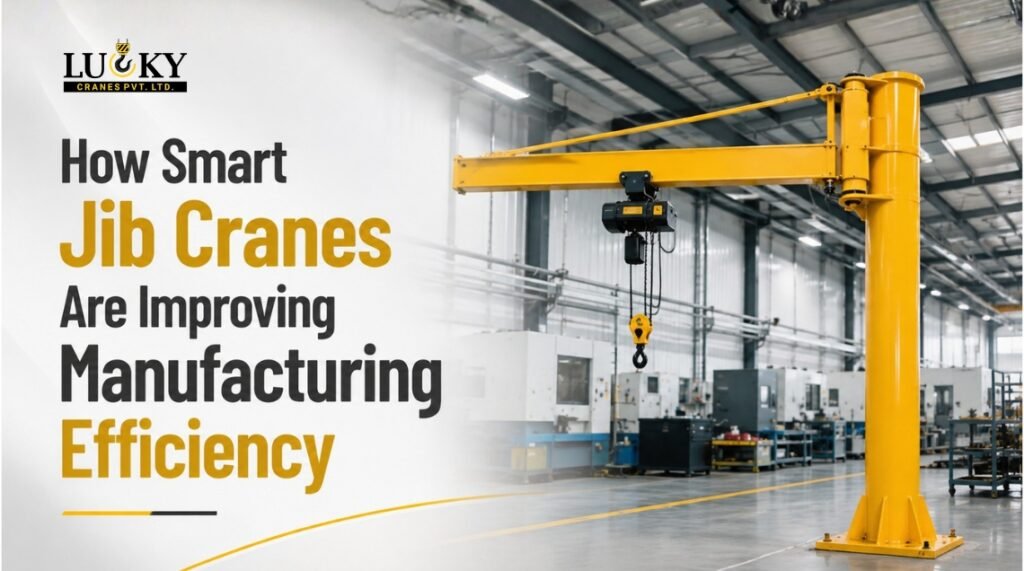
Modern manufacturing facilities are constantly looking for ways to improve productivity, reduce downtime, and create safer workplaces. Material handling plays an important role in achieving these goals. Among the various lifting solutions available today, smart jib cranes are becoming increasingly valuable for manufacturing and industrial operations.
A jib crane provides localized lifting and material handling within a defined work area. Its compact design makes it suitable for workstations, assembly lines, workshops, and production units where fast and controlled load movement is required.
What Makes a Jib Crane Smart?
Traditional jib cranes are already effective for repetitive lifting operations. However, modern smart jib cranes can incorporate advanced controls, sensors, monitoring systems, and automation features to make operations more precise and efficient.
These technologies can help operators control lifting and positioning more smoothly while providing useful information about crane usage and equipment performance. Smart features can also support preventive maintenance by helping identify unusual operating conditions before they lead to major problems.
Improving Material Handling Efficiency
In manufacturing, unnecessary movement and waiting time can affect overall production efficiency. A jib crane installed close to a workstation allows operators to lift, move, and position materials without depending on a larger shared crane.
This can reduce material handling time and help maintain a consistent production workflow. For repetitive operations, having dedicated lifting equipment at the workstation can be particularly useful.
Smart control systems can further improve positioning accuracy, helping workers handle components with greater control and reducing unnecessary movement during lifting operations.
Supporting Workplace Safety
Manual lifting and movement of heavy components can increase the risk of workplace injuries. Jib cranes reduce the need for workers to manually handle heavy loads by providing controlled mechanical lifting.
Modern safety features such as overload protection, limit switches, emergency-stop systems, and other control technologies can further support safer crane operation.
By combining proper equipment design with trained operators and regular maintenance, manufacturers can create a safer and more efficient material-handling environment.
Saving Valuable Factory Space
Space is an important consideration in modern manufacturing facilities. Jib cranes are designed for localized lifting and require comparatively limited operating space. Wall-mounted configurations can be especially useful where floor space is restricted, while floor-mounted systems can provide dedicated lifting coverage around specific workstations.
This makes jib cranes a practical choice for facilities where installing a large overhead crane system may not be necessary for every area.
Enabling Smarter Manufacturing
As manufacturers move toward Industry 4.0, connected equipment and data-driven operations are becoming increasingly important. Smart lifting systems can potentially be integrated with monitoring and production systems to provide information about operating hours, load cycles, equipment usage, and maintenance requirements.
Such data can help maintenance teams plan servicing more effectively and reduce the possibility of unexpected equipment downtime.
Applications Across Manufacturing Industries
Smart jib cranes can support a wide range of applications, including assembly operations, machine loading and unloading, fabrication, maintenance, workshops, automotive production, and warehouse activities. Their ability to provide controlled lifting within a specific work zone makes them suitable for both repetitive and specialized material-handling tasks.
Conclusion
Smart jib cranes are helping manufacturers improve the way materials are lifted, moved, and positioned on the shop floor. By combining compact design, controlled lifting, improved safety features, and modern monitoring capabilities, they can contribute to better productivity and more organized workflows.
For manufacturers looking to optimize specific workstations without major infrastructure changes, a customized jib crane can be an effective material-handling solution. Selecting the right lifting capacity, mounting configuration, boom length, and control features ensures that the crane matches the facility’s operational requirements. Lucky Cranes provides customized jib crane solutions designed for different industrial applications and lifting requirements.